I frequently run across the CVs of high-level wetland professionals who each claim to be a "USACE Certified Wetland Delineator." Hmmm. That's all well and good - after all, the annals of wetland management and regulation are full of tales of both consultants and regulatory staff making egregious wetland boundary errors during wetland delineations - errors which impact everything from legitimate economic uses of land, to vital aquatic habitats that might be hard to recognize. There could - and should - be some way to make sure everyone in the field, including government employees, is competent to do this type of work. Here's the problem - there's no such program at the federal level. No such certification. No such thing as a "USACE Certified Wetland Delineator." From a 2007 mailer released by NC State University:
"The US Army Corps Wetland Delineator Certification Program (WDCP) was canceled in 2003 before implementation. The WDCP does not exist (emphasis added) and the Corps has no plans to resurrect it."
In 2011, a webpage from Rutgers University similarly stated,
"There is currently no official certification program offered through the ACOE."
So, now that we can verify that there are, in fact, no Corps-certified delineators, let's back up a bit. In 1992, the Corps announced the formation of the Wetland Delineator Certification Program (WDCP). Meetings between the regulated and regulatory community produced an important bridge concept - that both regulatory staff and for-profit consultants should be certified prior to making legal determinations (or recommendations) on wetland boundaries. In the halls of Congress, as well as in the headquarters of the US Army Corps of Engineers - this made perfect sense. That's what produced the first failure.
A select group of Corps, USDA, and USFWS wetland experts worked quickly to develop the certification program - one that would include both written and field testing. As the mythology goes (I wasn't in the room, and trust me, this is not well documented), upon seeing drafts of the exam, Corps regulatory managers began to increasingly voice concerns that their staff may not have the basic wetland delineation training or professional experience necessary to pass the two-part exam that was being prepared at that moment by the Corps' wetland experts. Then (this part we know to be true), magically, without notifying the "regulated community" (infrastructure agencies, developers, etc), the portion of the WDCP that required certification of Corps field staff was quietly eliminated. Suddenly, this new grand plan - one that arose from massive wetland delineation failures on the part of permit applicants as well as regulatory staff - only sought to scrutinize and certify permit applicants - not government staff. Of course, this is problematic at its most basic level because Corps field staff wield an enormous amount of legal authority over wetland boundaries, and whether avoidance, minimization, and mitigation approaches are appropriate. If the "mythology" is true, then, to concede that their staff was not competent to represent the agency was a major blunder.
The ranks of private sector supporters of the WDCP shrank very quickly, but the process went on anyway. The end result was a "provisional certification" that would be awarded, and perhaps revisited if - not when - the WDCP became a formal, nationwide program. Several hundred consultants took the exam and nearly half of them passed the written portion. Nearly all who passed the written portion also passed the field portion of the exam. These several hundred men and women - most of them now age 45-55, were awarded the title "Provisional Certified Wetland Delineator."
Side note: for those of you unfamiliar with the legal moniker of "provisional," I'll provide an example. If you apply for a hunting license and lack a piece of required information, like the ID# on your hunter safety card, then the state will issue you a "provisional" license. It's "provisional" because it requires additional steps to take place for you to actually garner the title of "licensed hunter." Basically, "you are certified...PROVIDED THAT..(insert requirements for future action). " Back to our story...
At the time, the "Provisional" delineation title was granted because the program was not official, and had not passed "official rule making," a critical part of any time of federal award, certification, or regulation. The "provisional" status of those professionals who passed the two-part exam was intended to be immediately (say, within three years) rolled into the nationwide WDCP in 1997, at the very latest. But although the Corps proposed its final recommendations for the WDCP to Congress in 1995, the program languished until the Corps officially eliminated the WDCP in 2003. Most telling, perhaps is the Corps' final report to Congress in 1998, which reports the following: "Government Levels Affected: None." That only is important if your title related to that Congressional action is "provisional" - in which case, your status is now nil.
Finally, adding insult to injury for the then-young professionals who jumped through the hoops of the written application, the written test, and the field test (all administered by agency staff who would never have to take the test) have to suffer through the knowledge that the Corps of Engineers does not maintain a list of their names. Why? I don't have a good answer for that.
I'm sorry, ladies and gentlemen. If an agency certified you provisionally as a wetland delineator 20 years ago, in a test/demonstration program that was never offered throughout the agency's jurisdiction, a program that was never funded, never fully approved by Congress, then you actually cannot be a "Corps Certified Wetland Delineator." Then, if they never converted your provisional status to "full certified" in those 20 years, and on top of that, they do not maintain a list of you and your cohorts who successfully completed your exam, then you, my friends, are unfortunately not "Corps Certified Wetland Delineators." You are, of course, a "Formerly Provisionally Certified Wetland Delineator, 1992-1997, Expired" which is not AT ALL the same thing as a "Corps Certified Wetland Delineator."
I'm not blaming you - please don't think I am. I'm blaming the Corps, who let this die on the vine, and your certification with it.
Showing posts with label wetland regulation. Show all posts
Showing posts with label wetland regulation. Show all posts
Monday, January 7, 2013

Wednesday, December 12, 2012
Why Federal Wetland Regulations Still Don't Work - 40 Years After CWA
40 years ago, the Clean Water Act was passed, requiring the cleanup of the nation's interstate waters to a "fishable, drinkable, swimmable" standard by 1984. It's nearly 2013, and despite billions of dollars invested in regulatory programs headed by the EPA, US Army Corps of Engineers, and environmental agencies in several states, we are still losing wetlands. Even when those lost wetlands are replaced with new ones, the new ones almost always fail to reproduce the natural functions of the lost wetlands. For 20 years, American presidents and their EPA Directors have been talking about "no net loss" of wetlands. So let's look at the baseline for "no net loss."

Wow. So "no net loss" really means "We are accepting that we'll never get back the 30-90% of wetland acreage and functions that we already lost." From a conservation perspective, that is pathetic. Now let's look at what our esteemed wetland regulators are actually doing to preserve the functions and acreage of the remaining 10-70% of wetland acreage in the United States.
The Army Corps of Engineers, charged with protecting wetlands and streams with interstate connections, approves over 80% of all impact requests (filling, draining, dredging), and the agency has historically bragged to developers and Congress that they approve over 99% of completed applications for such impacts (many permit applications come with sketchy information and inadequate documentation, and are not deemed "complete").
So what about the "replacement" or mitigation, for these impacts, which is critical to achieve the elusive "no net loss" of wetland and stream acreage? One study found that permittees routinely recreate less than 50% of the required acreage. To say nothing of the "functional replacement" of the wetlands approved for filling/draining. In a similar study in Colorado, over 50% of designed mitigation wetlands were constructed smaller than promised. Other studies have shown that while "some" mitigation wetlands achieve the required acreage, none of them achieve the functional requirements and needs stipulated by scientists and regulatory agencies.
In fact, in 2005, the US Governmental Accounting Agency issued a report whose actual title was - I kid you not - "Corps of Engineers Does Not Have an Effective Oversight Approach to Ensure that Compensatory Mitigation is Occurring." Ouch! I mean - that's just the title!!!! It goes into 47 pages of detail on the topic.
I've been in meetings with Corps managers since that report, and those staff have basically said, "This surprised us - we'll get right to it!"
But it shouldn't have surprised them. Witness the 1988 GAO Report, entitled, "The Corps of Engineers' Administration of the Section 404 Program." From the report:
"Undetected (wetland and stream) violations of permit requirements may be occurring. Also, some suspected unauthorized activities reported to the Corps may not be investigated for months after they are reported, and many projects are not inspected by the Corps for compliance with permit conditions."
Hmm. So....how the Corps was surprised in 2005, when they (and Congress) were informed of the same issues in 1988 is a little beyond me. How in the world can these federal agencies be claiming "no net loss of wetlands" with straight faces, as they are consistently documented as not having even laid eyes on wetland impact and replacement/mitigation projects? Certainly is a mystery to me.
Then we can head back to 2004, when the GAO issued a report to Congress entitled, "Corps of Engineers Needs to Evaluate its District Office Practices." The main theme? Even though every office of the Corps of Engineers follows the same federal laws and standards, there is little to no consistency across the country of what, and how, and why the Corps of Engineers might enforce. This inconsistency and failure to follow official federal protocol has led to 15 years of crushing defeats in the US Supreme Court (and DC Federal Court, whose rulings impact Corps Headquarters, and thus, all Corps offices) that have drastically undercut the federal government's ability to regulate interstate waters and wetlands. That's right, incompetence did that.
And there's more:
GAO 2005: "Army Corps Needs to Better Support its Decisions"
GAO 1993: "Scope of 404 Program Remains Uncertain" (22 years after passage of Clean Water Act)
The sad fact is that when a federal wetland regulator states that "this impact" or "that impact" are not allowed and would not receive a permit, they are generally lying. The documents linked above, and hundreds of similar documents and court findings, have shown that our federal wetland regulations, and regulators, are not particularly effective at protecting a whole heck of a lot, particularly once politics, money, constitutionality, and basic professional competence and protocol come into the picture.
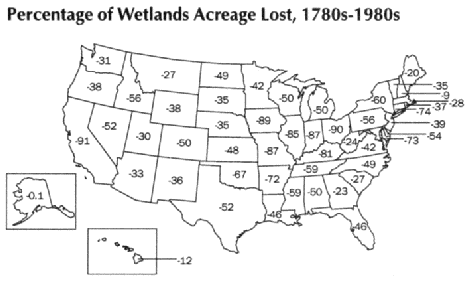
Wow. So "no net loss" really means "We are accepting that we'll never get back the 30-90% of wetland acreage and functions that we already lost." From a conservation perspective, that is pathetic. Now let's look at what our esteemed wetland regulators are actually doing to preserve the functions and acreage of the remaining 10-70% of wetland acreage in the United States.
The Army Corps of Engineers, charged with protecting wetlands and streams with interstate connections, approves over 80% of all impact requests (filling, draining, dredging), and the agency has historically bragged to developers and Congress that they approve over 99% of completed applications for such impacts (many permit applications come with sketchy information and inadequate documentation, and are not deemed "complete").
So what about the "replacement" or mitigation, for these impacts, which is critical to achieve the elusive "no net loss" of wetland and stream acreage? One study found that permittees routinely recreate less than 50% of the required acreage. To say nothing of the "functional replacement" of the wetlands approved for filling/draining. In a similar study in Colorado, over 50% of designed mitigation wetlands were constructed smaller than promised. Other studies have shown that while "some" mitigation wetlands achieve the required acreage, none of them achieve the functional requirements and needs stipulated by scientists and regulatory agencies.
In fact, in 2005, the US Governmental Accounting Agency issued a report whose actual title was - I kid you not - "Corps of Engineers Does Not Have an Effective Oversight Approach to Ensure that Compensatory Mitigation is Occurring." Ouch! I mean - that's just the title!!!! It goes into 47 pages of detail on the topic.
I've been in meetings with Corps managers since that report, and those staff have basically said, "This surprised us - we'll get right to it!"
But it shouldn't have surprised them. Witness the 1988 GAO Report, entitled, "The Corps of Engineers' Administration of the Section 404 Program." From the report:
"Undetected (wetland and stream) violations of permit requirements may be occurring. Also, some suspected unauthorized activities reported to the Corps may not be investigated for months after they are reported, and many projects are not inspected by the Corps for compliance with permit conditions."
Hmm. So....how the Corps was surprised in 2005, when they (and Congress) were informed of the same issues in 1988 is a little beyond me. How in the world can these federal agencies be claiming "no net loss of wetlands" with straight faces, as they are consistently documented as not having even laid eyes on wetland impact and replacement/mitigation projects? Certainly is a mystery to me.
Then we can head back to 2004, when the GAO issued a report to Congress entitled, "Corps of Engineers Needs to Evaluate its District Office Practices." The main theme? Even though every office of the Corps of Engineers follows the same federal laws and standards, there is little to no consistency across the country of what, and how, and why the Corps of Engineers might enforce. This inconsistency and failure to follow official federal protocol has led to 15 years of crushing defeats in the US Supreme Court (and DC Federal Court, whose rulings impact Corps Headquarters, and thus, all Corps offices) that have drastically undercut the federal government's ability to regulate interstate waters and wetlands. That's right, incompetence did that.
And there's more:
GAO 2005: "Army Corps Needs to Better Support its Decisions"
GAO 1993: "Scope of 404 Program Remains Uncertain" (22 years after passage of Clean Water Act)
The sad fact is that when a federal wetland regulator states that "this impact" or "that impact" are not allowed and would not receive a permit, they are generally lying. The documents linked above, and hundreds of similar documents and court findings, have shown that our federal wetland regulations, and regulators, are not particularly effective at protecting a whole heck of a lot, particularly once politics, money, constitutionality, and basic professional competence and protocol come into the picture.
 |
| Source: USFS |
Subscribe to:
Posts (Atom)