Showing posts with label hiring. Show all posts

Wednesday, August 1, 2012

Some Notes for Your Second Career in the Environmental Field

Congratulations.  Congratulations on making through possibly an entire career already, and hopefully having some kind of pension.  Congratulations on going back to school to earn one or more environmental degrees - when no one was forcing you (or helping you, or paying for you) to do so.  Congratulations on finishing that schooling.  I hope I'm just as motivated as you, at that stage of my career.  So let's talk.

Too many second-careerists are doing it all wrong, and it's been seriously bumming me out (some language that both your generation and mine (Gen X) can appreciate).   The colleges have fed you a bit of a lie - and I'm not sure why they did it, because the truth would earn them the same or more tuition dollars from you.    The lie?  That you, a 55-70 year old, can substantively compete in an outdoor, seasonal, off-road career field with an army of career-hungry 22-year olds.   I'm not talking about hiring (that would be age discrimination).  I'm talking about the actual job.  For instance, are you ready to:

1) Knowingly expose yourself, repeatedly, to Lyme Disease, day after day, and be in situations where there's no more bug spray and plenty more ticks?......you just have to go get in the woods and work. You are going to get tick bites.  You'll probably need to get antibiotics for Lyme.  Maybe even annually.

2) Work outdoors through cuts that require stitches, multiple bee stings, and snow/rain/ice downpours?  My edict for more than a decade was that my field crews worked in all conditions except lightning and icy roads. Yes, some people did cry, in fact.  Several of them. It was hard.  It was work.  It had to get done.  If our crew was 3 hours from home, and we'd already worked an 8 hour field day (plus a 2 hour drive that morning), and we had 4 more hours of work to do, NO we are not coming back tomorrow.  We are finishing it tonight.  Call your husbands and wives.  Enjoy the OT pay.  But don't complain.

3) Work outdoors for multiple 12+ hour field days in a row, just to return to a crummy hotel in a crummy town full of crummy restaurants? And by multiple days, I mean "two years."

4) Work in snake and alligator infested areas without proper protection in the interest of "getting the job done?"

5) Swim across a hot, stagnant ditch because to walk around it would take another hour? And then keep working outside in wet clothes that you know are filled with all awful manner of nasty bacteria and fungi?

Those are not atypical work conditions for entry-level employees in the environmental field.  And while I've certainly phrased it as, "Are you cut out for this?", I think the more proper question is, "Isn't there a better use of your talents within the environmental field?"  I've met far too many second careerists in the environmental field who feel an incredible sense of "vertical integrity" - folks who think they are obligated to start at the bottom of the field and put in their work, like the young people.  To them, I say, "I respect that, but you are out of your freaking mind."
Field work for your college class.  Aww - friends and dry shoes!
High five!


Field work in real life: Long, lonely days in tough field conditions.

The environmental field is built upon the backs of young people who can work for cheap and who want to prove that they love the environment and/or their job more than their peers do.   That no challenge is too great.  No working conditions unacceptable.  That any gargantuan task can be completed in any infantesimile (sp?) increment of time.  Not enough daylight?  We'll work under headlamps.  There's ice?  I got crampons.    And of course, I can fly out on Saturday to get an "early start."    I did it.  Many of us did.

It's fun, rewarding, challenging, and occasionally pretty miserable. The highs are pretty nifty but the lows are not to be trifled with, alone in your hotel room, sunburned and frostbitten in the same day, both pairs of boots are sopping wet, still hungry because Applebee's sucks, and the hotel bar is full of drunk townies and a single tap of Busch Light...........with your spouse calling and asking why you didn't tell you boss "No."  And at that moment, your Local on the 8s pops up on your hotel TV, showing tomorrow's high temperature: 23 degrees, winds 25mph, wind chill of 10 degrees. Or, 109 degrees, and 90% humidity. Ah, the open road.

The best part about those entry level ecologists is that their time is billed at a very low rate, they don't take much vacation, they rarely ask for raises, and they never take sick days, except to play hookey or nurse a hangover.  An ecologist with 2 years experience can do about 40% of what an ecologist with 10 years experience can do, and probably bills out at 75% less per hour.   Entry level ecologists don't sit around and theorize and make lofty decisions.  Entry level ecologists are the sharp end of the pencil. And nobody cares if the point breaks.  You just grab a new pencil, or ram the old one into that overpowered sharpener....
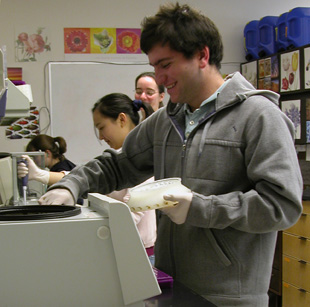
Environmental science lab at college - learnin' science, chillin' with friends!
Who said happy hour?!

Real life lab ecologists.  Boss over your shoulder 10 hours per day.

Competing against that machine, in my opinion, is useless and a waste of your time.  Instead, I recommend that you try to jump immediately into lower/mid management.  This is helped, of course, if you worked in management in your prior career - even if it had nothing to do with the environment.

Take business classes.  Make notes of exactly how many staff you trained and supervised over the course of your first career.  Take a night and write down what you learned about people (as a whole)  from supervising them.  Witty anecdotes.  Real lessons.  Ask yourself: Do I possess the strength and the empathy to be a leader in the environmental field? 

There are many people in very high positions in government environmental agencies and enviro-corporate America that have little to no environmental technical/college background.  I'd say that 25% of the "industry's" leadership has little technical training in the field.  Press secretaries who became deputy directors.  Marketing folks who became department heads.  And lawyers, oh the lawyers.   And here's the good part - as someone who's finished your environmental college degree - you've got one up on them.  It's fabulous.   The hard part  is to just physically get in the room when the right people are there to meet you and learn about you - and hopefully remember you for that next big vacancy.  Given your high motivation level to date, I think you can break through the barriers that keep you from that.

In short, don't burn yourself out trying to be an entry-level soldier in the environmental field.  Hopefully, you've learned something about work-life balance by this point in your life, and you'll see that taking your career in that direction would be a serious misstep.  Think about what angles you can play to move more effectively into low or mid-level management - or higher - and let your second career develop from that point.

Good luck!

Sunday, July 15, 2012

5 Reasons You Won't Get Hired in the Environmental Science Field

I recently ran across an AOL article entitled "10 Reasons You Didn't Get the Job."  Some of the things on the list are pretty ridiculous, like, "You arrived too early for the interview!" (if you are on the east or west coast, and need to plan on traffic or transit delays, you may, in fact, be 20 minutes early).  Others, like an interviewer's push to get the applicant to discuss salary, are a sad but true reason that a candidate can out themselves as either over - or under- qualified for the position (or totally qualified but with an alarmingly high or low opinion of their own professional value).

There's a whole separate list that's applicable just to the environmental field, and the applicant - especially those just entering the field as recent graduates or second-careerists - should know about these things.   Over the last 15 years, I've hired, supervised, and mentored a few dozen people - almost all of them biologists and engineers.

5. Lack of Self-Motivation.  I don't have to tell you what the job market is like out there.  It's going to get better.  Maybe not easier.  But better.  In any job climate, one of the quickest and easiest ways to knock yourself out of consideration for an environmental position is to be unengaged in the community.  I once asked a really qualified candidate what he'd been doing in the months since he finished his Masters Degree.  He answered, "Uhh, pretty much just chillin'."   I personally called him (long after he found out he didn't get the job) and gave him this same advice - it's that basic and that important.   He ultimately decided to become a science teacher at a local high school instead of becoming a professional ecologist.


I'm not suggesting that you spend 90 hours a week volunteering for environmental organizations. But if you want to be in the environmental field, and you can't find a paying gig (yet), use your free time wisely to at least infer to potential employers that ecology (or soil science, or whatever) are more than just a job and a paycheck for you.  If you truly love it, then spend time in it.  For the record, better answers would have included, "Hiking the A.T. and trying to rediscover my spirituality" or "puttin' some time in at my Mom's farm, you know, little wildlife projects here and there." Or better yet, "I have a small business building wood duck boxes (even if you have only built 2, and sold both to your Dad). Here's my business card -  it's my way of staying active in the field until I find work." 

4.  Don't know the players, don't know the game. Whether you are on the academic or the private consulting ends of ecology and environmental science, it's absolutely critical from the start of your career to know who the major players are, and what the major issues are in your chosen sub-field.   For example, my subfield is wetland restoration.  I would not hire anyone for a paid position that didn't know the meanings and importance of most of these words: "SWANCC" "Rapanos" "Carabell" "CREP" "404".   Furthermore, if the job description I'd posted had any reference to our primary funding sources, I'd expect each applicant to have looked up those websites and know basic acronyms like WRP, NFWF, NAWCA, and SRLF.   I'd expect them to know the names of several of the active, high profile scientists, landscape architects, land managers, and engineers in our state. 


This all may sound trite, but it's important.  There are many different theories about ecological theories and about environmental laws, and those all tend to conflict and inform (and sometimes misinform) each other.  When you walk into a job, you need to know, on a very basic level, who will oppose your work and why.  Who supports it, and why?  


3. Basic technical knowledge.   The job market is tough out there.  We're on the east coast, where jobs are semi-available, but not keeping pace with the staggering number of graduates within environmental college programs (to say nothing of other types of college graduates who happen to have practical environmental experience....or political connections).  Okay, now that I've said all that, PLEASE DO NOT APPLY FOR JOBS IN HIGHLY POPULATED AREAS IF YOU ARE NOT QUALIFIED FOR THE JOBS.  If you've never spent time in a wetland, and want to apply for a wetland permitting job in Idaho?  Go for it, I guess.  Florida, California, or Pennsylvania?  Do not waste your time, or the time of the person reviewing the resume's.

When it comes time for the interview, for the love of God, be prepared.  If it's a primate job, know the difference between old world and new world primates.  A wetland job?  Know the 10 most common wetland plants in the area where the job is located (lists are available for most states). A job with birds? Know the status (endangered vs. common vs. pest) of as many locally present birds as possible.  This type of knowledge, even if only lodged in your short-term memory, serves two purposes:  1) immediately inspires confidence in the interviewer to think, "OK this person can walk in the door and do this job," and 2) fills your interview time with witty banter about orchard orioles, some-story-about-Jane-Goodall, or the last special natural place you visited.  All of those things are better than getting battered by interview questions!  And if you don't know some real stuff about your sub-field, you will probably fail this test.

2.  Outspoken Attitudes about Job-Related Topics.  Do enough homework to know what topics not to discuss.  Do enough practice interviews to be able to soundly defend your ethical and moral values on these topics.  Don't ever lie (you'll hate yourself if you do get the job) - but be prepared to defend yourself in a polite but robust way. The biggest ones, if bungled on your end, that could quickly turn off a potential employer (so much so that they might immediately end the interview):
a. The role, importance, failings, and hazards of environmental regulations
b. The role of active habitat management vs. landscape preservation (aka "throw away the key")
c. The role of fishing and hunting in conservation and population dynamics
d. Animal rights issues, as they apply to environmental management, animal testing in research, and everything inbetween.
e. The role of guerrilla activism in environmental science and conservation.

Remember that if you are searching for jobs in a defined geographical area, you're likely to run into your interviewer again at some point.  Wouldn't you hate it if what they remember you for is some off-the-cuff comment you made about "An anarchist takeover of America would be best for biodiversity."  Yikes. 

1. Atrocious Resumes.  Yup.  This is nothing new.  IF YOU ARE 22 YEARS OLD YOU DO NOT NEED A SIX PAGE RESUME'.   Did I make that clear?  Hiring entry-level environmental staff is a crap shoot at best.  No one cares that you had a soils class that one time, or that you totally did the weekend sojourn with the Forestry Club that one time.

Your ONE PAGE RESUME' needs to confine itself to your contact information, education, truly relevant work experience (not Victoria's Secret), and somewhat relevant leadership (not just volunteer) experience (yes: "I organized the Young Alumni Dinner."  no: "I volunteered at the dinner").

Please also:

*Do not misspell anything.
*Do not have a ridiculous email address like, "HotRedhead84"
*Do not list truly demeaning jobs unless it's a story you just *have* to tell, i.e. you started by spraying out port-a-potties at age 17 for minimum wage, and then bought the company three years later, at age 20.

Tuesday, July 10, 2012

Four Hiring Gimmicks (or Benefits?) in the Environmental Sciences

So, you're looking for an environmental job.  A lot of young (under 40) ecologists and other environmental scientists are pretty displeased with their standing right now.   In many agencies and organizations, the average employee is a 45-55 year old man.  Studies predict that by 2020, the average environmental scientist will be 30-35 and male (though by a shrinking margin).  Doesn't sound like much, but it's a massive shift, and it's one that agencies, universities, and companies expected to occur a decade ago.  

As an entire generation reluctantly retires, experienced scientists (say, age 27 to 45) across the field are doing the work of several employees, and have not been given the opportunities for advancement that their parents were (Director at 36? Gee, that sounds swell!).  Because those scientists are still on "staff" and not middle or upper management, the lack of entry level vacancies has been absolutely astounding.  In a field that desperately needs new blood, there's little to be found.  So far.

When you read those job ads and they list their benefits, they sure sound great, don't they?  Well, if you're new to the field, here's what some of those really mean.  If nothing else, you owe it to yourself to ask questions.

Flexible Work Hours.  Go into any restaurant, especially a fast food restaurant.  They will undoubtedly have a hiring poster on the wall, and on that poster will say, "Flexible Schedule!"  It does not take a rocket scientist (or even an ecologist) to realize that the "flexible" part does not, and was never intended to, benefit the employees of that restaurant.  "Flexible" means they might not put you on the schedule for 10 days.  And then the following week, schedule you for 60 hours.  "Flexible" means working an extra shift, with no notice. "Flexible" does not mean you can call out of work because your baby is sick.  None for you!

In the professional world, it's not nearly as bad.  But you should ask yourself (and your potential employer), "What is flexible?"  Nearly 70% of all companies now have "flex time," a percentage that is increasingly weekly, but in your first week there, you may notice that everyone still gets to the office around 8:00am, because that was the policy for 30 years, up until 2010, when flex time was introduced.  Despite "flex time," other employees may ask each other (or your supervisor) why you come in late every day (despite the fact that you also stay late), or why you "get to" leave early every day (despite the fact that you also arrive at the office early).  And despite flex time, if your boss wants something from you at 9:05am, and your hours are 9:15-5:45; or she wants something from you at 5:05pm, and your hours are 7:30am - 4:00pm, you are sure going to hear about it.  


Tip: ask how many of the employees take advantage of the flex time policy.  Ask when the office is "mostly full" on monday mornings and "mostly empty" on friday afternoons.  That should give you an idea of what the expected hours might truly be.  Flexible work hours can be a huge benefit to you - and data shows that worker productivity and retention are improved as a result.

Professional Development.  Depending on the workplace and the nature of the professional development policy itself, well-funded professional development can be a boon or a depressor to employees.  Have an idea of courses you actually want to take, either for your own enrichment or for your career (I differentiate between the two).  Before you accept a job offer, be sure to very, very briefly discuss your list of potential courses you'd like to take.........if they are somewhat applicable to the job.   Most workplaces will now offer professional development, but that could mean anything from trust-building exercises to very serious courses (with exams) that are held 2,000 miles away from home.  You may or may not want either one of those extremes.


Tip: Just give it some thought - what do YOU want? 

Telecommuting.  Yes, 2/3 of American companies already allow exempt, professional-level employees to telecommute.  Yes, by 2020, that fraction is likely to be closer to 9/10 by 2020.   That means less traffic and more laptops.   But we need to back up a second.  Remember that your new supervisor is likely to be between age 40 and 65.  He or she was probably never, ever given an opportunity to telecommute.  He or she was taught how to manage employees that are sitting in an office (or at least physically reporting to the office once a day), not how to manage a bunch of "minds" that may be scattered across the eastern seaboard and logging onto their laptops at 8:00am to start the workday.

That, my friends, means trouble.  It means that in many workplaces, this "benefit" (that you may have formally negotiated) will be trotted out as a "privilege" at inopportune times. Your boss (like two former managers I knew (ironic - both eventually lost their jobs)) may very well be suspicious of your activities on telecommuting days.   If other coworkers do not have this benefit, they will likely talk about it as well. Is it a battle worth fighting?


Tip: Yes, it's worth fighting for.  At the risk of sounding like an old fuddy-duddy, give your supervisor something to chew on, on days that you telecommute.  E-mail them early and often, and be sure to be at your laptop and ready to answer e-mails throughout the day.  Make sure to accomplish some significant body of work during the day, so you have something to bring back to the office with you.  Some folks would rather not fight it, and just give this benefit up, rather than have to defend themselves constantly.  Be prepared to make that decision.  Again, the majority of American companies now allow professional-level employees to work from home at least occasionally (monthly or weekly).   The nation's managers are still trying to figure out how to best manage it (and us). 

Paid Vacation.  All professionals get vacation!  Well, yes.  Almost all of us accrue vacation.  My current workplace (5 employees) encourages us to spend it periodically, so we don't end up taking a paid month off and crippling the office's operations.  That's a good thing.  Yet, in many workplaces, scientists simply never take their vacation time.  Sometimes it's a personal choice - we tend to love our work.  And in some cases, vacation requests may be denied.

But in the majority of cases, we simply don't take vacation because recovering (at work) from "being off" for more than about two days can take weeks (it's referred to as "digging out.").   Also note that if your particular type of work is seasonally dependent, your ability to take paid vacation (until you become a manager) will be limited to periods outside the "busy season."   No matter what, you do not want to be in a workplace that hinders its employees from taking reasonable time off (i.e. at least the paid annual leave or vacation pay that you accrue).

Tip: Ask your interviewer, or any of the employees your interviewer allows you to meet, what percentage of their accrued vacation they get to take per year.  Please do not ask them how many days they earned and how many days they used.  People are sensitive about that!  Your goal is to find out that "average employees earn 3 weeks but only use 1.5" or "they earn 2 weeks and only use 2 days."  That is precious and powerful information!