Showing posts with label professionalism. Show all posts

Monday, July 20, 2015

When Scientists Take Bad Advice....

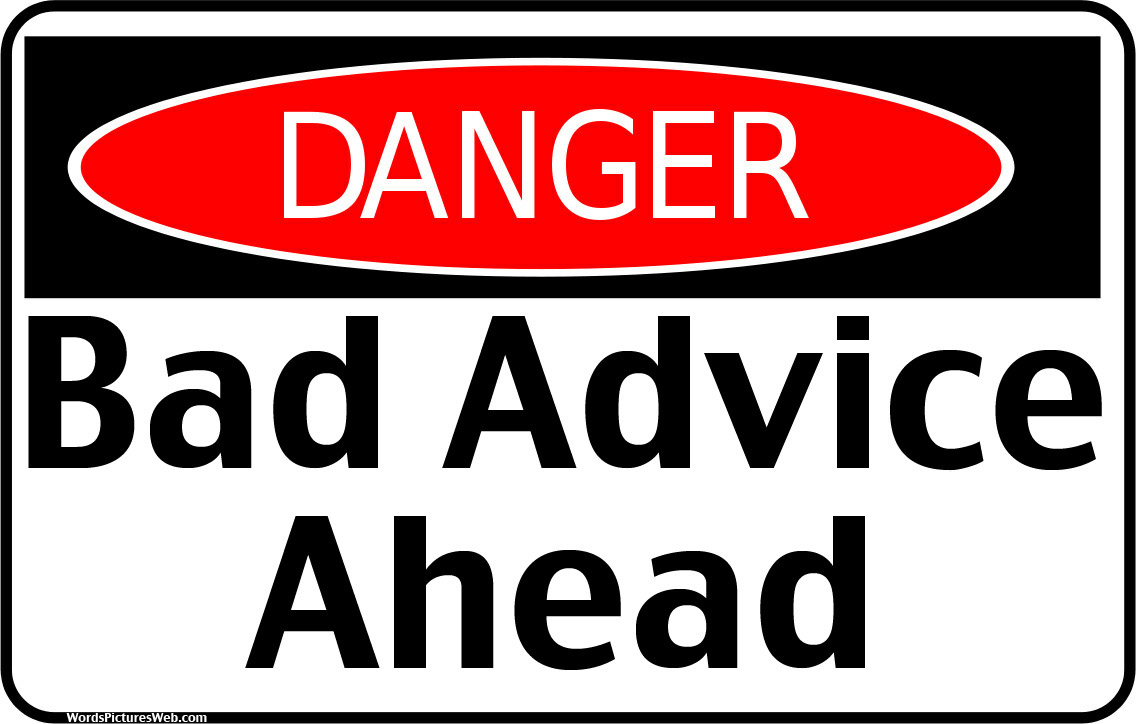
If only the people dispensing bad professional advice,
actually wore this label. 
A colleague (and friend of over 10 years) was recently pushed out of a job that she meant to keep for the remainder of her career.  She didn't do anything (criminally) illegal, waste her employers' resources, or commit any kind of timesheet fraud, or call in sick from Disney World.   She took some bad professional advice and paid dearly.

This colleague had the pleasure (or displeasure, depending on the day) of overseeing construction compliance with water projects in Annapolis, which happens to be the Maryland state capital in addition to being nearly surrounded by water.  This means a few things:

1.  Some people in Annapolis expect to be able to access (or build over) the water, regardless of laws.
2.  Most people with waterfront property in Annapolis have access to disposable money.
3.  Most people with waterfront property in Annapolis have access to political influence.
4.  Most people with waterfront property in Annapolis have access to good legal counsel.

In other words, if you have to deal with these folks in a situation where they want you to approve something you're not sure you can legally approve, you'll need to be highly competent, extremely patient in the face of petulance and immaturity, and have the good fortune or good judgment to be receiving good counsel, both in a legal sense and in a mentoring sense.

My friend, at her former job, had all of those things except a good mentor.   She worked on several contentious cases over the years, and worked diligently.  Although there were many complaints, that could be seen as a reflection of doing a good job in an "enforcement" position.   I mean....maybe.  But then she encountered one of "those" people, asking for permission to build something that my friend wasn't sure she could approve.  The person proposing the work was:

1.  Someone in Annapolis who has been very effective at getting his way with water regulations.
2.  Someone with access to disposable cash (in a general sense).
3.  Someone with a great deal of political influence
4.  Someone who was, in fact, a lawyer with a license to practice.

Letters from the "lawyer with free time" and my "stick in the mud colleague" flew back and forth for months.    Very little progress seemed to be made with each volley.   My friend then asked an elder colleague, someone who is very politically insulated, how she should handle it.  She was told that "if it were him," he would reject the proposal outright, partly because the final approval window was closing just two days after she received the last volley of written responses.  

My friend denied that permit. Such a denial gives the permit applicant 7 days to file an appeal in circuit court, which he did.  The court summarily ruled against the state, calling the permit rejection "arbitrary and capricious" and directing the agency in charge to issue permits within 7 days.    Eventually the permit was issued, and the project was constructed.

The person seeking the permit still has his job.   The elder environmental spokesman dispensing bad advice to my colleague still has his job.  But my colleague does not.  How is that possible?

I suppose I don't know how to answer that without saying, "We all have to be grownups."  If you're 25, or 30, or 40 or 50, and you take bad advice from someone who is your senior, you'll be the one held accountable for the lapse in judgment.  Unfortunately, I've been there - I'm glad it did not cost me a job.   But this is how life works.   All of us have college degrees.  Most have a graduate degree or some amount of graduate school under our belts.  If you aren't sure when you're getting good or bad advice, have a plan in place to ask others around you.   Keep an eye on whether you can stomach the (realistic) possible consequences of taking such advice - just as if it were your own idea on how to handle the situation.

It's true that in a highly functioning work environment, your fellow professional would stand up and say, "That's my fault - I gave poor advice and the junior staff took it."  But that kind of admission is rare in both corporate and government offices, and you'd be foolish to expect that level of protection, especially if you are considered by others to be a "junior" employee.

Networking and giving/receiving advice are critical to your success as a scientist.  But just because something wasn't your idea doesn't mean it doesn't count, once things go wrong.  Hasn't that been true in other phases of your life?  You know, your parents with that dumb, "If your friends all jumped off a cliff....." story?

If a senior colleague with nothing to lose tells you, "Go jump off that cliff, I'll be right behind you!", you'd be best to seek the counsel of another colleague to confirm the plan.


Monday, February 4, 2013

Is the Use of Regionally Sourced Plant Material a Valid Requirement for Plants in a Climate Change Scenario?

Here in Maryland, as in many states, the assembly of a restoration planting plan often requires the explicit statement: "All plant material is to be sourced from (name physiographic province of the state) region of (name a term that describes five states including yours)."  The idea, and it is a noble one, is to ensure that the New York Finger Lakes wetland you are building is populated by plant material that was not sourced from Washington state, which could cause a dilution of high quality genetics from the regionally appropriate plants.   One of the first (academic or regulatory) problems of this rule is that it is only applied to live plant material, and not to conservation seed mixes, even though those seed mixes contain seeds for perennial native plants.  Oops.

But there's a much larger problem with focusing on New York-bred plants for New York projects.  Take a look below.


The vast majority of the country should experience a 5 to 7 degree increase in mean temperature.  Now, mean temperatures are deceiving because it's actually the minimum temperatures that impact things like growing seasons, insect overwintering mortality, and seed viability.  But let's ignore that, or, rather than ignoring it, let's take a look at the USDA growing season map, which is dictated by lowest temperatures, not mean temperatures.


You gardeners may recall that just a year ago, USDA revised its plant zone map based upon climate change data that is already rolling in.   How might a 5 degree change in the next 40 years impact this map further?  Well, let's look at Maryland, largely a Zone 7a state (0-5 degrees - we haven't seen temperatures that low in a decade).  An increase of 5 to 7 degrees could place Maryland in Zone 8a, a solid subtropical coastal growing zone.   That's a lot of change in a short amount of time.  Maryland ecosystems could quite feasibly start acting like South Carolina ecosystems.  Which brings us back to the topic of regional plant genetics.

If I'm planting an emergent wetland where even perennial plants will succumb after less than 10 years, it seems to make great sense to utilize the most locally native plant genetics possible.  But what about planting an oak swamp?  An alder thicket?  An upland hickory forest stand?  What about plants that quite conceivably could still be alive as the climate changes drastically over the next 40 years?  

For long-lived plants used in forestry and restoration work, I propose abandoning the "regional plant genetics" preferences and requirements, and instead, for us to begin looking to our south to find strong genetics for plants that are tolerant of the stresses that climate change is likely to bring us - increased flooding, increased drought, unpredictability of precipitation, and warmer minimum temperatures.   In Maryland, for example, the Shumard Red Oak exists in the wild in our southernmost county.  Yet, it's never mentioned in conversations about forestry, forest habitat management, or habitat restoration because "It's Not Native."  I think this is foolish, and currently there are 200 Shumard acorns from northern North Carolina now hardening in my basement refrigerator, to be used on habitat restoration sites.

"This is preposterous!" you might say.  An alternate example with a different story ending is the Sugar Maple.  Most foresters and landscape architects stopped planting sugar maples in the Mid-Atlantic in the early 2000s because the summer droughts were killing huge numbers of trees.   Yet, our DNR Forestry Division still refers to Sugar Maple as a "Maryland Native Tree" - providing it to citizens to plant on their property!

Here's what's going on with the Sugar Maple:


The species is predicted to lose over 90% of its range.  It's already happening.  Why - as a professional community - can't we agree to change and accept new conditions around us?

So when you're considering a list of long-lived trees for a forestry, landscaping, or habitat restoration site, there's no need to stick to "the standards" for native plants in your area.   Please plan ahead, and perhaps your innovation to prepare habitat for climate change will be noted as part of your legacy.   It's certainly better than being known as "the idiot who planted all these dead sugar maples 40 years ago."