Showing posts with label regulations. Show all posts

Wednesday, December 12, 2012

Why Federal Wetland Regulations Still Don't Work - 40 Years After CWA

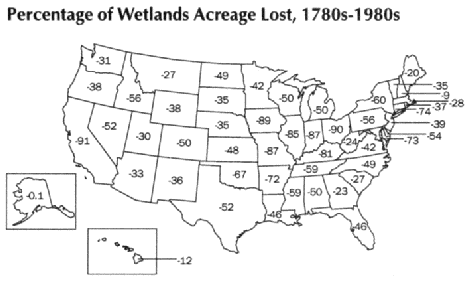
40 years ago, the Clean Water Act was passed, requiring the cleanup of the nation's interstate waters to a "fishable, drinkable, swimmable" standard by 1984.   It's nearly 2013, and despite billions of dollars invested in regulatory programs headed by the EPA, US Army Corps of Engineers, and environmental agencies in several states, we are still losing wetlands.  Even when those lost wetlands are replaced with new ones, the new ones almost always fail to reproduce the natural functions of the lost wetlands.   For 20 years, American presidents and their EPA Directors have been talking about "no net loss" of wetlands.   So let's look at the baseline for "no net loss."


Wow.  So "no net loss" really means "We are accepting that we'll never get back the 30-90% of wetland acreage and functions that we already lost."   From a conservation perspective, that is pathetic.   Now let's look at what our esteemed wetland regulators are actually doing to preserve the functions and acreage of the remaining 10-70% of wetland acreage in the United States.

The Army Corps of Engineers, charged with protecting wetlands and streams with interstate connections, approves over 80% of all impact requests (filling, draining, dredging), and the agency has historically bragged to developers and Congress that they approve over 99% of completed applications for such impacts (many permit applications come with sketchy information and inadequate documentation, and are not deemed "complete").

So what about the "replacement" or mitigation, for these impacts, which is critical to achieve the elusive "no net loss" of wetland and stream acreage?  One study found that permittees routinely recreate less than 50% of the required acreage.  To say nothing of the "functional replacement" of the wetlands approved for filling/draining.   In a similar study in Colorado, over 50% of designed mitigation wetlands were constructed smaller than promised.   Other studies have shown that while "some" mitigation wetlands achieve the required acreage, none of them achieve the functional requirements and needs stipulated by scientists and regulatory agencies. 

In fact, in 2005, the US Governmental Accounting Agency issued a report whose actual title was - I kid you not - "Corps of Engineers Does Not Have an Effective Oversight Approach to Ensure that Compensatory Mitigation is Occurring."  Ouch!  I mean - that's just the title!!!!  It goes into 47 pages of detail on the topic.
I've been in meetings with Corps managers since that report, and those staff have basically said, "This surprised us - we'll get right to it!"

But it shouldn't have surprised them.  Witness the 1988 GAO Report, entitled, "The Corps of Engineers' Administration of the Section 404 Program." From the report:

"Undetected (wetland and stream) violations of permit requirements may be occurring.  Also, some suspected unauthorized activities reported to the Corps may not be investigated for months after they are reported, and many projects are not inspected by the Corps for compliance with permit conditions."

Hmm.  So....how the Corps was surprised in 2005, when they (and Congress) were informed of the same issues in 1988 is a little beyond me.  How in the world can these federal agencies be claiming "no net loss of wetlands" with straight faces, as they are consistently documented as not having even laid eyes on wetland impact and replacement/mitigation projects?  Certainly is a mystery to me.

Then we can head back to 2004, when the GAO issued a report to Congress entitled, "Corps of Engineers Needs to Evaluate its District Office Practices."  The main theme?  Even though every office of the Corps of Engineers follows the same federal laws and standards, there is little to no consistency across the country of what, and how, and why the Corps of Engineers might enforce.  This inconsistency and failure to follow official federal protocol has led to 15 years of crushing defeats in the US Supreme Court (and DC Federal Court, whose rulings impact Corps Headquarters, and thus, all Corps offices) that have drastically undercut the federal government's ability to regulate interstate waters and wetlands.  That's right, incompetence did that.

And there's more:

GAO 2005: "Army Corps Needs to Better Support its Decisions"

GAO 1993: "Scope of 404 Program Remains Uncertain"  (22 years after passage of Clean Water Act)

The sad fact is that when a federal wetland regulator states that "this impact" or "that impact" are not allowed and would not receive a permit, they are generally lying.  The documents linked above, and hundreds of similar documents and court findings, have shown that our federal wetland regulations, and regulators, are not  particularly effective at protecting a whole heck of a lot, particularly once politics, money, constitutionality, and basic professional competence and protocol come into the picture.  

Source: USFS


Monday, October 8, 2012

Is 150 Years of Ecological Research Enough?

For over 100 years, humans have known that the exhaust from fossil fuel burning causes low-altitude air pollution, which makes workers and city dwellers sick.  For 150 years, we've known that cholera and other diseases are carried by water that is untreated and mismanaged. For 1,000 years, we've understood the nature of human-to-human contagions, their propagation in nature, and their utility on the world's battlefields. The use of pesticides goes back at least to the Roman rule of France.  Which has been over for awhile.

These issues continue to pose significant problems for the future of our species, and yet, our inability or unwillingness to tackle them have absolutely nothing to do with a lack of science, or inability to define the problem and the potential solutions.

So, as a natural resource manager, excuse me if I grow tired of hearing that this government agency (career position, with pension) or that university researcher (tenured, with pension) are not ready to proceed with environmental cleanups because there's no guarantee that conventional or existing, innovative restoration techniques may or may not be more effective and efficient than techniques that could perhaps be developed 50 or 100 years from now.   And yet, from some quarters within the highly environmentally aware community, that's exactly the meme that's being pushed from highly comfortable offices.

Obviously, there are fields in which continued - if not accelerated - research and research funding are critical.   Like cancer and genome research.  Those are good ones.

About five years ago, I was invited to do a presentation to a group of EPA scientists on the topic of ecological restoration efficiency.  They seemed pleased enough to listen to what I had to say, but as a group, were extraordinarily concerned with the possibility that, "What if 10 years from now, we find out that we could have been doing it a smarter way, all along?"  Which led to a strong head-nodding agreement that, "We should wait, let's not do anything now."

If you search through ecology blogs, as I occasionally do, there's a wealth of people writing about their research on this wolf, or that lichen, or that endangered fern.   I'd never claim that those are not worthy undertakings for a career in ecology or forest management or whatever.

But I can't imagine that if the Ogallala Aquifer runs dry, as predicted, in 12-20 years, it will matter.  Or that if our human population does in fact hit 12 billion, that it will matter.  Or that if global food production continues to decrease 0.5% annually, that it will matter.  Or that if China and India - fully making up 50% of the entire world's population - decide to go to war, that any of it will matter.

What will matter then is water, soil, and the food that comes from them.  Whether we beat those odds will be greatly impacted by what we do in the next decade to protect headwaters, protect groundwater, enhance food production (but not at the expense of virgin erodible soils/habitats), protect and enhance sustainable fisheries, and protect and enhance soils.   And by what we "do," I don't mean what we research.  I mean "what work gets accomplished."  Upgrading sewer plants.  Water treatment.  Agricultural targeting (both lands to protect against agriculture, and lands to protect FOR agriculture).  Getting it done.   Yes, we'll find out in 20 years that we can be doing it more efficiently.   That should be a triumph in our process - not the starting point for getting something done.

The only way I could answer those career bureaucrat scientists several years ago was with total honesty.  I told them that if we don't start today, it won't matter.  All those efficiencies we hope to discover in the coming decades will be lost because from 1970 to 2030, we did nothing, while knowing full well that the future of our species depended on sustainable water, soil, and food.   We know so much about the dynamics of water, soil, air, and wildlife.  In some cases, the dynamic nature of systems leads us back to the same point - entropy does, and must, exist.  And as a result, there will be failures.  Aqueducts designed by the Romans failed routinely.    Amsterdam's dike system has been built-and-rebuilt several times over.  Stream restoration projects designed in 1930, 1960, 1990, and 2010 have failed.   But most do not.   And from those efforts that fail, we learn much. 

So what will you do? If you're a researcher, when will you be confident in stating that, "this application of theory to field methods should work, most of the time."  If you're an agency biologist, when will you take the authority given to you by your agency and say, "Go ahead with this project.  It's far better than doing nothing."  Or will you say, once again, "more research is needed."


Sunday, July 15, 2012

5 Reasons You Won't Get Hired in the Environmental Science Field

I recently ran across an AOL article entitled "10 Reasons You Didn't Get the Job."  Some of the things on the list are pretty ridiculous, like, "You arrived too early for the interview!" (if you are on the east or west coast, and need to plan on traffic or transit delays, you may, in fact, be 20 minutes early).  Others, like an interviewer's push to get the applicant to discuss salary, are a sad but true reason that a candidate can out themselves as either over - or under- qualified for the position (or totally qualified but with an alarmingly high or low opinion of their own professional value).

There's a whole separate list that's applicable just to the environmental field, and the applicant - especially those just entering the field as recent graduates or second-careerists - should know about these things.   Over the last 15 years, I've hired, supervised, and mentored a few dozen people - almost all of them biologists and engineers.

5. Lack of Self-Motivation.  I don't have to tell you what the job market is like out there.  It's going to get better.  Maybe not easier.  But better.  In any job climate, one of the quickest and easiest ways to knock yourself out of consideration for an environmental position is to be unengaged in the community.  I once asked a really qualified candidate what he'd been doing in the months since he finished his Masters Degree.  He answered, "Uhh, pretty much just chillin'."   I personally called him (long after he found out he didn't get the job) and gave him this same advice - it's that basic and that important.   He ultimately decided to become a science teacher at a local high school instead of becoming a professional ecologist.


I'm not suggesting that you spend 90 hours a week volunteering for environmental organizations. But if you want to be in the environmental field, and you can't find a paying gig (yet), use your free time wisely to at least infer to potential employers that ecology (or soil science, or whatever) are more than just a job and a paycheck for you.  If you truly love it, then spend time in it.  For the record, better answers would have included, "Hiking the A.T. and trying to rediscover my spirituality" or "puttin' some time in at my Mom's farm, you know, little wildlife projects here and there." Or better yet, "I have a small business building wood duck boxes (even if you have only built 2, and sold both to your Dad). Here's my business card -  it's my way of staying active in the field until I find work." 

4.  Don't know the players, don't know the game. Whether you are on the academic or the private consulting ends of ecology and environmental science, it's absolutely critical from the start of your career to know who the major players are, and what the major issues are in your chosen sub-field.   For example, my subfield is wetland restoration.  I would not hire anyone for a paid position that didn't know the meanings and importance of most of these words: "SWANCC" "Rapanos" "Carabell" "CREP" "404".   Furthermore, if the job description I'd posted had any reference to our primary funding sources, I'd expect each applicant to have looked up those websites and know basic acronyms like WRP, NFWF, NAWCA, and SRLF.   I'd expect them to know the names of several of the active, high profile scientists, landscape architects, land managers, and engineers in our state. 


This all may sound trite, but it's important.  There are many different theories about ecological theories and about environmental laws, and those all tend to conflict and inform (and sometimes misinform) each other.  When you walk into a job, you need to know, on a very basic level, who will oppose your work and why.  Who supports it, and why?  


3. Basic technical knowledge.   The job market is tough out there.  We're on the east coast, where jobs are semi-available, but not keeping pace with the staggering number of graduates within environmental college programs (to say nothing of other types of college graduates who happen to have practical environmental experience....or political connections).  Okay, now that I've said all that, PLEASE DO NOT APPLY FOR JOBS IN HIGHLY POPULATED AREAS IF YOU ARE NOT QUALIFIED FOR THE JOBS.  If you've never spent time in a wetland, and want to apply for a wetland permitting job in Idaho?  Go for it, I guess.  Florida, California, or Pennsylvania?  Do not waste your time, or the time of the person reviewing the resume's.

When it comes time for the interview, for the love of God, be prepared.  If it's a primate job, know the difference between old world and new world primates.  A wetland job?  Know the 10 most common wetland plants in the area where the job is located (lists are available for most states). A job with birds? Know the status (endangered vs. common vs. pest) of as many locally present birds as possible.  This type of knowledge, even if only lodged in your short-term memory, serves two purposes:  1) immediately inspires confidence in the interviewer to think, "OK this person can walk in the door and do this job," and 2) fills your interview time with witty banter about orchard orioles, some-story-about-Jane-Goodall, or the last special natural place you visited.  All of those things are better than getting battered by interview questions!  And if you don't know some real stuff about your sub-field, you will probably fail this test.

2.  Outspoken Attitudes about Job-Related Topics.  Do enough homework to know what topics not to discuss.  Do enough practice interviews to be able to soundly defend your ethical and moral values on these topics.  Don't ever lie (you'll hate yourself if you do get the job) - but be prepared to defend yourself in a polite but robust way. The biggest ones, if bungled on your end, that could quickly turn off a potential employer (so much so that they might immediately end the interview):
a. The role, importance, failings, and hazards of environmental regulations
b. The role of active habitat management vs. landscape preservation (aka "throw away the key")
c. The role of fishing and hunting in conservation and population dynamics
d. Animal rights issues, as they apply to environmental management, animal testing in research, and everything inbetween.
e. The role of guerrilla activism in environmental science and conservation.

Remember that if you are searching for jobs in a defined geographical area, you're likely to run into your interviewer again at some point.  Wouldn't you hate it if what they remember you for is some off-the-cuff comment you made about "An anarchist takeover of America would be best for biodiversity."  Yikes. 

1. Atrocious Resumes.  Yup.  This is nothing new.  IF YOU ARE 22 YEARS OLD YOU DO NOT NEED A SIX PAGE RESUME'.   Did I make that clear?  Hiring entry-level environmental staff is a crap shoot at best.  No one cares that you had a soils class that one time, or that you totally did the weekend sojourn with the Forestry Club that one time.

Your ONE PAGE RESUME' needs to confine itself to your contact information, education, truly relevant work experience (not Victoria's Secret), and somewhat relevant leadership (not just volunteer) experience (yes: "I organized the Young Alumni Dinner."  no: "I volunteered at the dinner").

Please also:

*Do not misspell anything.
*Do not have a ridiculous email address like, "HotRedhead84"
*Do not list truly demeaning jobs unless it's a story you just *have* to tell, i.e. you started by spraying out port-a-potties at age 17 for minimum wage, and then bought the company three years later, at age 20.