Fundamental change is starting to occur within the realms of leadership within the environmental world. The change is based upon three premises - a transition of generations, a tiredness for protocol that never satisfied a scientific need and no longer satisfies political fancy, and an economy that demands accountability and direct results for startlingly tiny amounts of money. For those in the evening of their careers, it is certainly a dynamic time. I've been alarmed, however, that more senior environmental "leaders" don't feel positively about the "new generation" or about what is coming next. What follows will read to some as an ageist rant - it's anything but that. No, this is a rant about academic platitudes and literary happy hours. About 40 year old soap boxes that were never hurled through a window or burned in the street, but instead, kept on display as a monument to themselves.
What is leadership? There are two standard definitions, which both require examination for our purposes.
Leadership:
1. The action of leading
2. Having the position of a leader
The people who read this blog are smart people, and as a result, I shouldn't have to continue past that definition. You now know what I am preparing to say. But I'll say it anyway.
As a prime example - but one of very many on the scientific and political landscape - there's a certain "group of senior leaders" within the Chesapeake Bay watershed who think pretty highly of themselves and their CVs. They craft position papers for elected officials about once every 18 months, and true to the nature of such a group, they celebrate any success as a result of their input and leverage.....and deride any failure as the result of "corruption." Obviously I find that tactic a little childish but I tend to give them deference - good people trying to effect positive change. It has come to my attention that they also have a blog, which you can find here. Look again at those two definitions of "leadership," above, and peruse some of the most recent blog topics:
1. Complaining about a comprehensive plan revision after the comment period has been closed.
2. Bragging about their critical influence in the development of animal manure regulations, while simultaneously complaining that the resulting regulations are critically flawed and will not work.
3. Complaining about Perdue Chicken's disinformation campaign (that's truly what it was) associated with what most conservationists knew was an ill-advised dud of a lawsuit against Perdue Chicken. Now Perdue seeks $3 million in legal fees from the environmentalist plaintiffs....wonder if the Senior Leaders will help fundraise?
What consistently lacks in any of this is a road map to doing things differently. These "leaders," and so many thousands like them, still believe that their name or their organization's name gives them distinct political leverage (there's that second definition of "leadership" again) to have their voice heard above other voices - particularly, those singularly based in a motive for profit. They are wrong. They don't favor engagement or compromise. They simply tell stories of how good it all once was, how bad it currently is, and how much worse it could be, and hope that somehow, someone else will actually do the good work of conserving the world's air, soil, water, and biota. Increasingly, true political decision makers, as well as their anti-environment opponents, just shake their heads at best, and laugh at worst, as the platitude-holding "leaders" demand the same regulations they've been demanding for 30 years, with rapidly decreasing impact.
We - and I - don't need any more "senior environmental leaders" who are going to "tell us" how things are bad, fully lacking coherent, new ideas to make them better. Other than the passage of several (now) poorly enforced pollution laws over 40 years ago, their business plan of organizing and complaining has accomplished little. It is time, sirs and madams, for a new model.
We need leadership rooted in the "first definition." If I had my way, anyone touting themselves as a "leader" - let alone a "senior leader" - should be required to spend their time considering the following:
1. Teaching the next generations (two new generations are already in the field) about all of the science's (or the movement's) past failures and successes since 1969. What models are there? What pitfalls can be expected? How are opponents and antagonists created, emboldened, and eventually dissolved? What mistakes were made - were they inevitable? Were they necessary? How do we understand what that even means?
2. Having a high ranking government position and writing a book about environmental problems does not make you an environmental leader. It's great that you had some book tours, and you met two presidents. So what, if your life's work (cleanup of a river) remains totally incomplete? Consider writing a book that won't sell a million copies but will change lives - something like, "What the next generation must do to truly save the Bay." Or "How Your Home Must Save the Bay."
3. Stop complaining about problems that occur far after the point that they've exited your locus of control. A true leader is either connected enough to impact policy at its inception, or tactful enough to rally meaningful support at future decision points. STOP COMPLAINING ABOUT THINGS YOU DO NOT INTEND TO ACTUALLY EMBARK ON FIXING.
4. The 1970s model of environmental stewardship was essentially "My job is to bring awareness to the unwashed masses, and magically that will transform into a small army of activists that does not include me, who will then ensure that massive change occurs." Unfortunately, Eco Darth Vader, the last decade of behavioral environmental studies has shown that your generation's theory of creating engaged citizens absolutely DOES NOT WORK. We know the harm of tobacco, and we still smoke (I enjoy a Nicaraguan in a natural wrapper from time to time, myself). We know the harm of texting while driving, and we still do it. We know that we are strangling our own life support system (this planet), and yet, we don't stop. If you want to be a leader, now is the time to snap out of your 10, or 20, or 40 year slump and realize that you need to go out and build leaders, not just tell sad stories and threaten lawsuits from time to time.
When my generation (Generation X) retires in 30 years (60 years in the work force, no pension), our grown children will ask, "What did you do to make it better?" We know that will happen because we asked our parents (hippies turned venture capitalists) the same thing, and they've - by and large - never had an answer beyond, "We got the clean water act passed!" Those of you in that generation still have many years in front of you - make them the most impactful. Go out and recruit new scientists, new citizens, new activists. It's time to realize that a meaningful legacy will be carried out by those who respect and admire your actions to save life on earth, not just postulate about its hazards and woes over the course of a well-paid, pension-ensured career.
Leadership: The action of leading
Showing posts with label environmental regulation. Show all posts
Showing posts with label environmental regulation. Show all posts
Tuesday, February 26, 2013

Monday, February 4, 2013
Is the Use of Regionally Sourced Plant Material a Valid Requirement for Plants in a Climate Change Scenario?
Here in Maryland, as in many states, the assembly of a restoration planting plan often requires the explicit statement: "All plant material is to be sourced from (name physiographic province of the state) region of (name a term that describes five states including yours)." The idea, and it is a noble one, is to ensure that the New York Finger Lakes wetland you are building is populated by plant material that was not sourced from Washington state, which could cause a dilution of high quality genetics from the regionally appropriate plants. One of the first (academic or regulatory) problems of this rule is that it is only applied to live plant material, and not to conservation seed mixes, even though those seed mixes contain seeds for perennial native plants. Oops.
But there's a much larger problem with focusing on New York-bred plants for New York projects. Take a look below.

The vast majority of the country should experience a 5 to 7 degree increase in mean temperature. Now, mean temperatures are deceiving because it's actually the minimum temperatures that impact things like growing seasons, insect overwintering mortality, and seed viability. But let's ignore that, or, rather than ignoring it, let's take a look at the USDA growing season map, which is dictated by lowest temperatures, not mean temperatures.

You gardeners may recall that just a year ago, USDA revised its plant zone map based upon climate change data that is already rolling in. How might a 5 degree change in the next 40 years impact this map further? Well, let's look at Maryland, largely a Zone 7a state (0-5 degrees - we haven't seen temperatures that low in a decade). An increase of 5 to 7 degrees could place Maryland in Zone 8a, a solid subtropical coastal growing zone. That's a lot of change in a short amount of time. Maryland ecosystems could quite feasibly start acting like South Carolina ecosystems. Which brings us back to the topic of regional plant genetics.
If I'm planting an emergent wetland where even perennial plants will succumb after less than 10 years, it seems to make great sense to utilize the most locally native plant genetics possible. But what about planting an oak swamp? An alder thicket? An upland hickory forest stand? What about plants that quite conceivably could still be alive as the climate changes drastically over the next 40 years?
For long-lived plants used in forestry and restoration work, I propose abandoning the "regional plant genetics" preferences and requirements, and instead, for us to begin looking to our south to find strong genetics for plants that are tolerant of the stresses that climate change is likely to bring us - increased flooding, increased drought, unpredictability of precipitation, and warmer minimum temperatures. In Maryland, for example, the Shumard Red Oak exists in the wild in our southernmost county. Yet, it's never mentioned in conversations about forestry, forest habitat management, or habitat restoration because "It's Not Native." I think this is foolish, and currently there are 200 Shumard acorns from northern North Carolina now hardening in my basement refrigerator, to be used on habitat restoration sites.
"This is preposterous!" you might say. An alternate example with a different story ending is the Sugar Maple. Most foresters and landscape architects stopped planting sugar maples in the Mid-Atlantic in the early 2000s because the summer droughts were killing huge numbers of trees. Yet, our DNR Forestry Division still refers to Sugar Maple as a "Maryland Native Tree" - providing it to citizens to plant on their property!
Here's what's going on with the Sugar Maple:

The species is predicted to lose over 90% of its range. It's already happening. Why - as a professional community - can't we agree to change and accept new conditions around us?
So when you're considering a list of long-lived trees for a forestry, landscaping, or habitat restoration site, there's no need to stick to "the standards" for native plants in your area. Please plan ahead, and perhaps your innovation to prepare habitat for climate change will be noted as part of your legacy. It's certainly better than being known as "the idiot who planted all these dead sugar maples 40 years ago."
Wednesday, December 12, 2012
Why Federal Wetland Regulations Still Don't Work - 40 Years After CWA
40 years ago, the Clean Water Act was passed, requiring the cleanup of the nation's interstate waters to a "fishable, drinkable, swimmable" standard by 1984. It's nearly 2013, and despite billions of dollars invested in regulatory programs headed by the EPA, US Army Corps of Engineers, and environmental agencies in several states, we are still losing wetlands. Even when those lost wetlands are replaced with new ones, the new ones almost always fail to reproduce the natural functions of the lost wetlands. For 20 years, American presidents and their EPA Directors have been talking about "no net loss" of wetlands. So let's look at the baseline for "no net loss."

Wow. So "no net loss" really means "We are accepting that we'll never get back the 30-90% of wetland acreage and functions that we already lost." From a conservation perspective, that is pathetic. Now let's look at what our esteemed wetland regulators are actually doing to preserve the functions and acreage of the remaining 10-70% of wetland acreage in the United States.
The Army Corps of Engineers, charged with protecting wetlands and streams with interstate connections, approves over 80% of all impact requests (filling, draining, dredging), and the agency has historically bragged to developers and Congress that they approve over 99% of completed applications for such impacts (many permit applications come with sketchy information and inadequate documentation, and are not deemed "complete").
So what about the "replacement" or mitigation, for these impacts, which is critical to achieve the elusive "no net loss" of wetland and stream acreage? One study found that permittees routinely recreate less than 50% of the required acreage. To say nothing of the "functional replacement" of the wetlands approved for filling/draining. In a similar study in Colorado, over 50% of designed mitigation wetlands were constructed smaller than promised. Other studies have shown that while "some" mitigation wetlands achieve the required acreage, none of them achieve the functional requirements and needs stipulated by scientists and regulatory agencies.
In fact, in 2005, the US Governmental Accounting Agency issued a report whose actual title was - I kid you not - "Corps of Engineers Does Not Have an Effective Oversight Approach to Ensure that Compensatory Mitigation is Occurring." Ouch! I mean - that's just the title!!!! It goes into 47 pages of detail on the topic.
I've been in meetings with Corps managers since that report, and those staff have basically said, "This surprised us - we'll get right to it!"
But it shouldn't have surprised them. Witness the 1988 GAO Report, entitled, "The Corps of Engineers' Administration of the Section 404 Program." From the report:
"Undetected (wetland and stream) violations of permit requirements may be occurring. Also, some suspected unauthorized activities reported to the Corps may not be investigated for months after they are reported, and many projects are not inspected by the Corps for compliance with permit conditions."
Hmm. So....how the Corps was surprised in 2005, when they (and Congress) were informed of the same issues in 1988 is a little beyond me. How in the world can these federal agencies be claiming "no net loss of wetlands" with straight faces, as they are consistently documented as not having even laid eyes on wetland impact and replacement/mitigation projects? Certainly is a mystery to me.
Then we can head back to 2004, when the GAO issued a report to Congress entitled, "Corps of Engineers Needs to Evaluate its District Office Practices." The main theme? Even though every office of the Corps of Engineers follows the same federal laws and standards, there is little to no consistency across the country of what, and how, and why the Corps of Engineers might enforce. This inconsistency and failure to follow official federal protocol has led to 15 years of crushing defeats in the US Supreme Court (and DC Federal Court, whose rulings impact Corps Headquarters, and thus, all Corps offices) that have drastically undercut the federal government's ability to regulate interstate waters and wetlands. That's right, incompetence did that.
And there's more:
GAO 2005: "Army Corps Needs to Better Support its Decisions"
GAO 1993: "Scope of 404 Program Remains Uncertain" (22 years after passage of Clean Water Act)
The sad fact is that when a federal wetland regulator states that "this impact" or "that impact" are not allowed and would not receive a permit, they are generally lying. The documents linked above, and hundreds of similar documents and court findings, have shown that our federal wetland regulations, and regulators, are not particularly effective at protecting a whole heck of a lot, particularly once politics, money, constitutionality, and basic professional competence and protocol come into the picture.
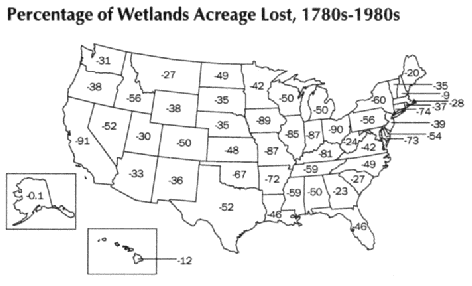
Wow. So "no net loss" really means "We are accepting that we'll never get back the 30-90% of wetland acreage and functions that we already lost." From a conservation perspective, that is pathetic. Now let's look at what our esteemed wetland regulators are actually doing to preserve the functions and acreage of the remaining 10-70% of wetland acreage in the United States.
The Army Corps of Engineers, charged with protecting wetlands and streams with interstate connections, approves over 80% of all impact requests (filling, draining, dredging), and the agency has historically bragged to developers and Congress that they approve over 99% of completed applications for such impacts (many permit applications come with sketchy information and inadequate documentation, and are not deemed "complete").
So what about the "replacement" or mitigation, for these impacts, which is critical to achieve the elusive "no net loss" of wetland and stream acreage? One study found that permittees routinely recreate less than 50% of the required acreage. To say nothing of the "functional replacement" of the wetlands approved for filling/draining. In a similar study in Colorado, over 50% of designed mitigation wetlands were constructed smaller than promised. Other studies have shown that while "some" mitigation wetlands achieve the required acreage, none of them achieve the functional requirements and needs stipulated by scientists and regulatory agencies.
In fact, in 2005, the US Governmental Accounting Agency issued a report whose actual title was - I kid you not - "Corps of Engineers Does Not Have an Effective Oversight Approach to Ensure that Compensatory Mitigation is Occurring." Ouch! I mean - that's just the title!!!! It goes into 47 pages of detail on the topic.
I've been in meetings with Corps managers since that report, and those staff have basically said, "This surprised us - we'll get right to it!"
But it shouldn't have surprised them. Witness the 1988 GAO Report, entitled, "The Corps of Engineers' Administration of the Section 404 Program." From the report:
"Undetected (wetland and stream) violations of permit requirements may be occurring. Also, some suspected unauthorized activities reported to the Corps may not be investigated for months after they are reported, and many projects are not inspected by the Corps for compliance with permit conditions."
Hmm. So....how the Corps was surprised in 2005, when they (and Congress) were informed of the same issues in 1988 is a little beyond me. How in the world can these federal agencies be claiming "no net loss of wetlands" with straight faces, as they are consistently documented as not having even laid eyes on wetland impact and replacement/mitigation projects? Certainly is a mystery to me.
Then we can head back to 2004, when the GAO issued a report to Congress entitled, "Corps of Engineers Needs to Evaluate its District Office Practices." The main theme? Even though every office of the Corps of Engineers follows the same federal laws and standards, there is little to no consistency across the country of what, and how, and why the Corps of Engineers might enforce. This inconsistency and failure to follow official federal protocol has led to 15 years of crushing defeats in the US Supreme Court (and DC Federal Court, whose rulings impact Corps Headquarters, and thus, all Corps offices) that have drastically undercut the federal government's ability to regulate interstate waters and wetlands. That's right, incompetence did that.
And there's more:
GAO 2005: "Army Corps Needs to Better Support its Decisions"
GAO 1993: "Scope of 404 Program Remains Uncertain" (22 years after passage of Clean Water Act)
The sad fact is that when a federal wetland regulator states that "this impact" or "that impact" are not allowed and would not receive a permit, they are generally lying. The documents linked above, and hundreds of similar documents and court findings, have shown that our federal wetland regulations, and regulators, are not particularly effective at protecting a whole heck of a lot, particularly once politics, money, constitutionality, and basic professional competence and protocol come into the picture.
 |
| Source: USFS |
Subscribe to:
Posts (Atom)