Fundamental change is starting to occur within the realms of leadership within the environmental world. The change is based upon three premises - a transition of generations, a tiredness for protocol that never satisfied a scientific need and no longer satisfies political fancy, and an economy that demands accountability and direct results for startlingly tiny amounts of money. For those in the evening of their careers, it is certainly a dynamic time. I've been alarmed, however, that more senior environmental "leaders" don't feel positively about the "new generation" or about what is coming next. What follows will read to some as an ageist rant - it's anything but that. No, this is a rant about academic platitudes and literary happy hours. About 40 year old soap boxes that were never hurled through a window or burned in the street, but instead, kept on display as a monument to themselves.
What is leadership? There are two standard definitions, which both require examination for our purposes.
Leadership:
1. The action of leading
2. Having the position of a leader
The people who read this blog are smart people, and as a result, I shouldn't have to continue past that definition. You now know what I am preparing to say. But I'll say it anyway.
As a prime example - but one of very many on the scientific and political landscape - there's a certain "group of senior leaders" within the Chesapeake Bay watershed who think pretty highly of themselves and their CVs. They craft position papers for elected officials about once every 18 months, and true to the nature of such a group, they celebrate any success as a result of their input and leverage.....and deride any failure as the result of "corruption." Obviously I find that tactic a little childish but I tend to give them deference - good people trying to effect positive change. It has come to my attention that they also have a blog, which you can find here. Look again at those two definitions of "leadership," above, and peruse some of the most recent blog topics:
1. Complaining about a comprehensive plan revision after the comment period has been closed.
2. Bragging about their critical influence in the development of animal manure regulations, while simultaneously complaining that the resulting regulations are critically flawed and will not work.
3. Complaining about Perdue Chicken's disinformation campaign (that's truly what it was) associated with what most conservationists knew was an ill-advised dud of a lawsuit against Perdue Chicken. Now Perdue seeks $3 million in legal fees from the environmentalist plaintiffs....wonder if the Senior Leaders will help fundraise?
What consistently lacks in any of this is a road map to doing things differently. These "leaders," and so many thousands like them, still believe that their name or their organization's name gives them distinct political leverage (there's that second definition of "leadership" again) to have their voice heard above other voices - particularly, those singularly based in a motive for profit. They are wrong. They don't favor engagement or compromise. They simply tell stories of how good it all once was, how bad it currently is, and how much worse it could be, and hope that somehow, someone else will actually do the good work of conserving the world's air, soil, water, and biota. Increasingly, true political decision makers, as well as their anti-environment opponents, just shake their heads at best, and laugh at worst, as the platitude-holding "leaders" demand the same regulations they've been demanding for 30 years, with rapidly decreasing impact.
We - and I - don't need any more "senior environmental leaders" who are going to "tell us" how things are bad, fully lacking coherent, new ideas to make them better. Other than the passage of several (now) poorly enforced pollution laws over 40 years ago, their business plan of organizing and complaining has accomplished little. It is time, sirs and madams, for a new model.
We need leadership rooted in the "first definition." If I had my way, anyone touting themselves as a "leader" - let alone a "senior leader" - should be required to spend their time considering the following:
1. Teaching the next generations (two new generations are already in the field) about all of the science's (or the movement's) past failures and successes since 1969. What models are there? What pitfalls can be expected? How are opponents and antagonists created, emboldened, and eventually dissolved? What mistakes were made - were they inevitable? Were they necessary? How do we understand what that even means?
2. Having a high ranking government position and writing a book about environmental problems does not make you an environmental leader. It's great that you had some book tours, and you met two presidents. So what, if your life's work (cleanup of a river) remains totally incomplete? Consider writing a book that won't sell a million copies but will change lives - something like, "What the next generation must do to truly save the Bay." Or "How Your Home Must Save the Bay."
3. Stop complaining about problems that occur far after the point that they've exited your locus of control. A true leader is either connected enough to impact policy at its inception, or tactful enough to rally meaningful support at future decision points. STOP COMPLAINING ABOUT THINGS YOU DO NOT INTEND TO ACTUALLY EMBARK ON FIXING.
4. The 1970s model of environmental stewardship was essentially "My job is to bring awareness to the unwashed masses, and magically that will transform into a small army of activists that does not include me, who will then ensure that massive change occurs." Unfortunately, Eco Darth Vader, the last decade of behavioral environmental studies has shown that your generation's theory of creating engaged citizens absolutely DOES NOT WORK. We know the harm of tobacco, and we still smoke (I enjoy a Nicaraguan in a natural wrapper from time to time, myself). We know the harm of texting while driving, and we still do it. We know that we are strangling our own life support system (this planet), and yet, we don't stop. If you want to be a leader, now is the time to snap out of your 10, or 20, or 40 year slump and realize that you need to go out and build leaders, not just tell sad stories and threaten lawsuits from time to time.
When my generation (Generation X) retires in 30 years (60 years in the work force, no pension), our grown children will ask, "What did you do to make it better?" We know that will happen because we asked our parents (hippies turned venture capitalists) the same thing, and they've - by and large - never had an answer beyond, "We got the clean water act passed!" Those of you in that generation still have many years in front of you - make them the most impactful. Go out and recruit new scientists, new citizens, new activists. It's time to realize that a meaningful legacy will be carried out by those who respect and admire your actions to save life on earth, not just postulate about its hazards and woes over the course of a well-paid, pension-ensured career.
Leadership: The action of leading
Showing posts with label age discrimination. Show all posts
Showing posts with label age discrimination. Show all posts
Tuesday, February 26, 2013

Wednesday, August 1, 2012
Some Notes for Your Second Career in the Environmental Field
Congratulations. Congratulations on making through possibly an entire career already, and hopefully having some kind of pension. Congratulations on going back to school to earn one or more environmental degrees - when no one was forcing you (or helping you, or paying for you) to do so. Congratulations on finishing that schooling. I hope I'm just as motivated as you, at that stage of my career. So let's talk.
Too many second-careerists are doing it all wrong, and it's been seriously bumming me out (some language that both your generation and mine (Gen X) can appreciate). The colleges have fed you a bit of a lie - and I'm not sure why they did it, because the truth would earn them the same or more tuition dollars from you. The lie? That you, a 55-70 year old, can substantively compete in an outdoor, seasonal, off-road career field with an army of career-hungry 22-year olds. I'm not talking about hiring (that would be age discrimination). I'm talking about the actual job. For instance, are you ready to:
1) Knowingly expose yourself, repeatedly, to Lyme Disease, day after day, and be in situations where there's no more bug spray and plenty more ticks?......you just have to go get in the woods and work. You are going to get tick bites. You'll probably need to get antibiotics for Lyme. Maybe even annually.
2) Work outdoors through cuts that require stitches, multiple bee stings, and snow/rain/ice downpours? My edict for more than a decade was that my field crews worked in all conditions except lightning and icy roads. Yes, some people did cry, in fact. Several of them. It was hard. It was work. It had to get done. If our crew was 3 hours from home, and we'd already worked an 8 hour field day (plus a 2 hour drive that morning), and we had 4 more hours of work to do, NO we are not coming back tomorrow. We are finishing it tonight. Call your husbands and wives. Enjoy the OT pay. But don't complain.
3) Work outdoors for multiple 12+ hour field days in a row, just to return to a crummy hotel in a crummy town full of crummy restaurants? And by multiple days, I mean "two years."
4) Work in snake and alligator infested areas without proper protection in the interest of "getting the job done?"
5) Swim across a hot, stagnant ditch because to walk around it would take another hour? And then keep working outside in wet clothes that you know are filled with all awful manner of nasty bacteria and fungi?
Those are not atypical work conditions for entry-level employees in the environmental field. And while I've certainly phrased it as, "Are you cut out for this?", I think the more proper question is, "Isn't there a better use of your talents within the environmental field?" I've met far too many second careerists in the environmental field who feel an incredible sense of "vertical integrity" - folks who think they are obligated to start at the bottom of the field and put in their work, like the young people. To them, I say, "I respect that, but you are out of your freaking mind."
The environmental field is built upon the backs of young people who can work for cheap and who want to prove that they love the environment and/or their job more than their peers do. That no challenge is too great. No working conditions unacceptable. That any gargantuan task can be completed in any infantesimile (sp?) increment of time. Not enough daylight? We'll work under headlamps. There's ice? I got crampons. And of course, I can fly out on Saturday to get an "early start." I did it. Many of us did.
It's fun, rewarding, challenging, and occasionally pretty miserable. The highs are pretty nifty but the lows are not to be trifled with, alone in your hotel room, sunburned and frostbitten in the same day, both pairs of boots are sopping wet, still hungry because Applebee's sucks, and the hotel bar is full of drunk townies and a single tap of Busch Light...........with your spouse calling and asking why you didn't tell you boss "No." And at that moment, your Local on the 8s pops up on your hotel TV, showing tomorrow's high temperature: 23 degrees, winds 25mph, wind chill of 10 degrees. Or, 109 degrees, and 90% humidity. Ah, the open road.
The best part about those entry level ecologists is that their time is billed at a very low rate, they don't take much vacation, they rarely ask for raises, and they never take sick days, except to play hookey or nurse a hangover. An ecologist with 2 years experience can do about 40% of what an ecologist with 10 years experience can do, and probably bills out at 75% less per hour. Entry level ecologists don't sit around and theorize and make lofty decisions. Entry level ecologists are the sharp end of the pencil. And nobody cares if the point breaks. You just grab a new pencil, or ram the old one into that overpowered sharpener....
Competing against that machine, in my opinion, is useless and a waste of your time. Instead, I recommend that you try to jump immediately into lower/mid management. This is helped, of course, if you worked in management in your prior career - even if it had nothing to do with the environment.
Take business classes. Make notes of exactly how many staff you trained and supervised over the course of your first career. Take a night and write down what you learned about people (as a whole) from supervising them. Witty anecdotes. Real lessons. Ask yourself: Do I possess the strength and the empathy to be a leader in the environmental field?
There are many people in very high positions in government environmental agencies and enviro-corporate America that have little to no environmental technical/college background. I'd say that 25% of the "industry's" leadership has little technical training in the field. Press secretaries who became deputy directors. Marketing folks who became department heads. And lawyers, oh the lawyers. And here's the good part - as someone who's finished your environmental college degree - you've got one up on them. It's fabulous. The hard part is to just physically get in the room when the right people are there to meet you and learn about you - and hopefully remember you for that next big vacancy. Given your high motivation level to date, I think you can break through the barriers that keep you from that.
In short, don't burn yourself out trying to be an entry-level soldier in the environmental field. Hopefully, you've learned something about work-life balance by this point in your life, and you'll see that taking your career in that direction would be a serious misstep. Think about what angles you can play to move more effectively into low or mid-level management - or higher - and let your second career develop from that point.
Good luck!
Too many second-careerists are doing it all wrong, and it's been seriously bumming me out (some language that both your generation and mine (Gen X) can appreciate). The colleges have fed you a bit of a lie - and I'm not sure why they did it, because the truth would earn them the same or more tuition dollars from you. The lie? That you, a 55-70 year old, can substantively compete in an outdoor, seasonal, off-road career field with an army of career-hungry 22-year olds. I'm not talking about hiring (that would be age discrimination). I'm talking about the actual job. For instance, are you ready to:
1) Knowingly expose yourself, repeatedly, to Lyme Disease, day after day, and be in situations where there's no more bug spray and plenty more ticks?......you just have to go get in the woods and work. You are going to get tick bites. You'll probably need to get antibiotics for Lyme. Maybe even annually.
2) Work outdoors through cuts that require stitches, multiple bee stings, and snow/rain/ice downpours? My edict for more than a decade was that my field crews worked in all conditions except lightning and icy roads. Yes, some people did cry, in fact. Several of them. It was hard. It was work. It had to get done. If our crew was 3 hours from home, and we'd already worked an 8 hour field day (plus a 2 hour drive that morning), and we had 4 more hours of work to do, NO we are not coming back tomorrow. We are finishing it tonight. Call your husbands and wives. Enjoy the OT pay. But don't complain.
3) Work outdoors for multiple 12+ hour field days in a row, just to return to a crummy hotel in a crummy town full of crummy restaurants? And by multiple days, I mean "two years."
4) Work in snake and alligator infested areas without proper protection in the interest of "getting the job done?"
5) Swim across a hot, stagnant ditch because to walk around it would take another hour? And then keep working outside in wet clothes that you know are filled with all awful manner of nasty bacteria and fungi?
Those are not atypical work conditions for entry-level employees in the environmental field. And while I've certainly phrased it as, "Are you cut out for this?", I think the more proper question is, "Isn't there a better use of your talents within the environmental field?" I've met far too many second careerists in the environmental field who feel an incredible sense of "vertical integrity" - folks who think they are obligated to start at the bottom of the field and put in their work, like the young people. To them, I say, "I respect that, but you are out of your freaking mind."
 |
| Field work for your college class. Aww - friends and dry shoes! High five! |
 |
| Field work in real life: Long, lonely days in tough field conditions. |
The environmental field is built upon the backs of young people who can work for cheap and who want to prove that they love the environment and/or their job more than their peers do. That no challenge is too great. No working conditions unacceptable. That any gargantuan task can be completed in any infantesimile (sp?) increment of time. Not enough daylight? We'll work under headlamps. There's ice? I got crampons. And of course, I can fly out on Saturday to get an "early start." I did it. Many of us did.
It's fun, rewarding, challenging, and occasionally pretty miserable. The highs are pretty nifty but the lows are not to be trifled with, alone in your hotel room, sunburned and frostbitten in the same day, both pairs of boots are sopping wet, still hungry because Applebee's sucks, and the hotel bar is full of drunk townies and a single tap of Busch Light...........with your spouse calling and asking why you didn't tell you boss "No." And at that moment, your Local on the 8s pops up on your hotel TV, showing tomorrow's high temperature: 23 degrees, winds 25mph, wind chill of 10 degrees. Or, 109 degrees, and 90% humidity. Ah, the open road.
The best part about those entry level ecologists is that their time is billed at a very low rate, they don't take much vacation, they rarely ask for raises, and they never take sick days, except to play hookey or nurse a hangover. An ecologist with 2 years experience can do about 40% of what an ecologist with 10 years experience can do, and probably bills out at 75% less per hour. Entry level ecologists don't sit around and theorize and make lofty decisions. Entry level ecologists are the sharp end of the pencil. And nobody cares if the point breaks. You just grab a new pencil, or ram the old one into that overpowered sharpener....
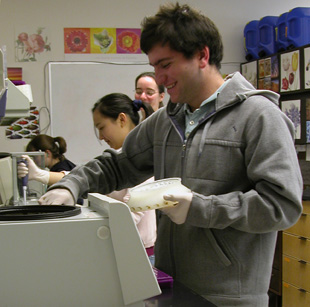 |
| Environmental science lab at college - learnin' science, chillin' with friends! Who said happy hour?! |
 |
| Real life lab ecologists. Boss over your shoulder 10 hours per day. |
Competing against that machine, in my opinion, is useless and a waste of your time. Instead, I recommend that you try to jump immediately into lower/mid management. This is helped, of course, if you worked in management in your prior career - even if it had nothing to do with the environment.
Take business classes. Make notes of exactly how many staff you trained and supervised over the course of your first career. Take a night and write down what you learned about people (as a whole) from supervising them. Witty anecdotes. Real lessons. Ask yourself: Do I possess the strength and the empathy to be a leader in the environmental field?
There are many people in very high positions in government environmental agencies and enviro-corporate America that have little to no environmental technical/college background. I'd say that 25% of the "industry's" leadership has little technical training in the field. Press secretaries who became deputy directors. Marketing folks who became department heads. And lawyers, oh the lawyers. And here's the good part - as someone who's finished your environmental college degree - you've got one up on them. It's fabulous. The hard part is to just physically get in the room when the right people are there to meet you and learn about you - and hopefully remember you for that next big vacancy. Given your high motivation level to date, I think you can break through the barriers that keep you from that.
In short, don't burn yourself out trying to be an entry-level soldier in the environmental field. Hopefully, you've learned something about work-life balance by this point in your life, and you'll see that taking your career in that direction would be a serious misstep. Think about what angles you can play to move more effectively into low or mid-level management - or higher - and let your second career develop from that point.
Good luck!
Subscribe to:
Posts (Atom)